
Webb study links dusty stellar discs to different planetary collisions
Astronomers found two mineral groups among extreme debris discs, suggesting collisions involving different sizes of planetary bodies.
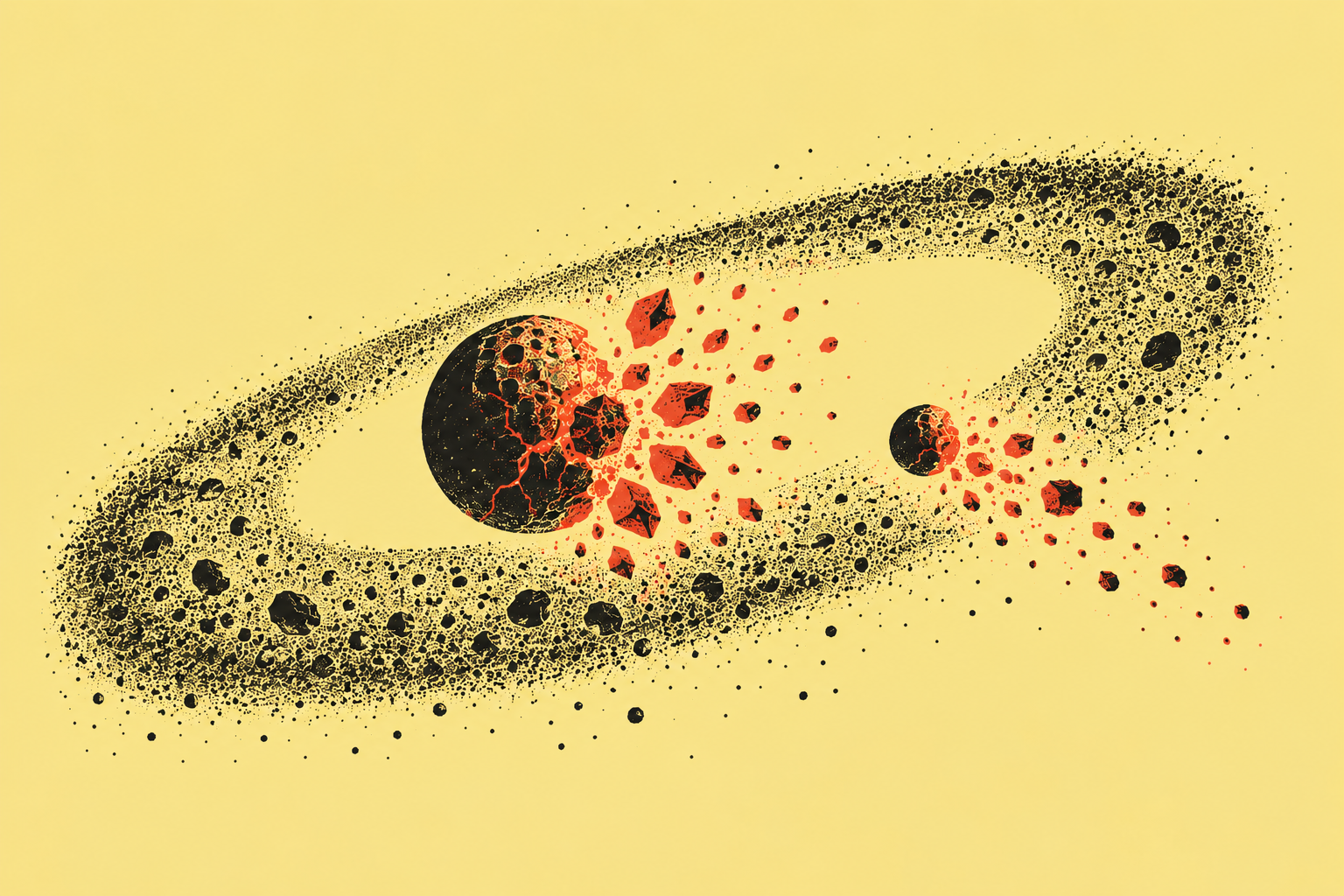 AI illustration
Astronomers studying dust around young stars have found mineral differences that suggest two types of collisions between planetary bodies. About one-third of the discs in their sample were rich in silica, suggesting high-energy impacts involving Mars-sized bodies that vapourised substantial amounts of material.
The remaining two-thirds were silica-poor, indicating smaller-scale encounters, such as grazing collisions between Moon-sized objects. The findings were described in an October 1 release by ESA/Webb (CC BY 4.0).
Kate Su of the Space Science Institute led the research, published in The Astrophysical Journal. The team assembled observations of 21 extreme debris discs using the James Webb Space Telescope and archival observations from the retired Spitzer Space Telescope.
These discs contain unusually abundant warm dust near their stars, in regions comparable to the rocky planets’ orbits in our Solar System. Scientists estimate roughly only 1% of young stars show observable evidence of this phase in the data collected so far, despite predictions that many should be visible.
Infrared spectra showed that the discs combine small dust grains, concentrations of warm material and irregular changes in brightness. Silica-rich examples appeared only around stars younger than 300 million years. Silica-poor discs covered a wider range of stellar ages and often varied more in brightness.
The researchers propose that repeated impacts and the rapid orbital and collisional evolution of fresh debris drive that variability. They say our Solar System may have experienced this dusty phase more than once. Coauthor Attila Moor cautioned that the sample contains only three older discs, leaving the hypothesis about their composition in need of further observations.