
MIT Study Shows How Brain Uses Neural Ensembles to Keep Decision Options Distinct
Neuroscientists at the Picower Institute found that the brain dynamically reorganizes representations of options by presentation order before a choice and by chosen or unchosen status afterward.
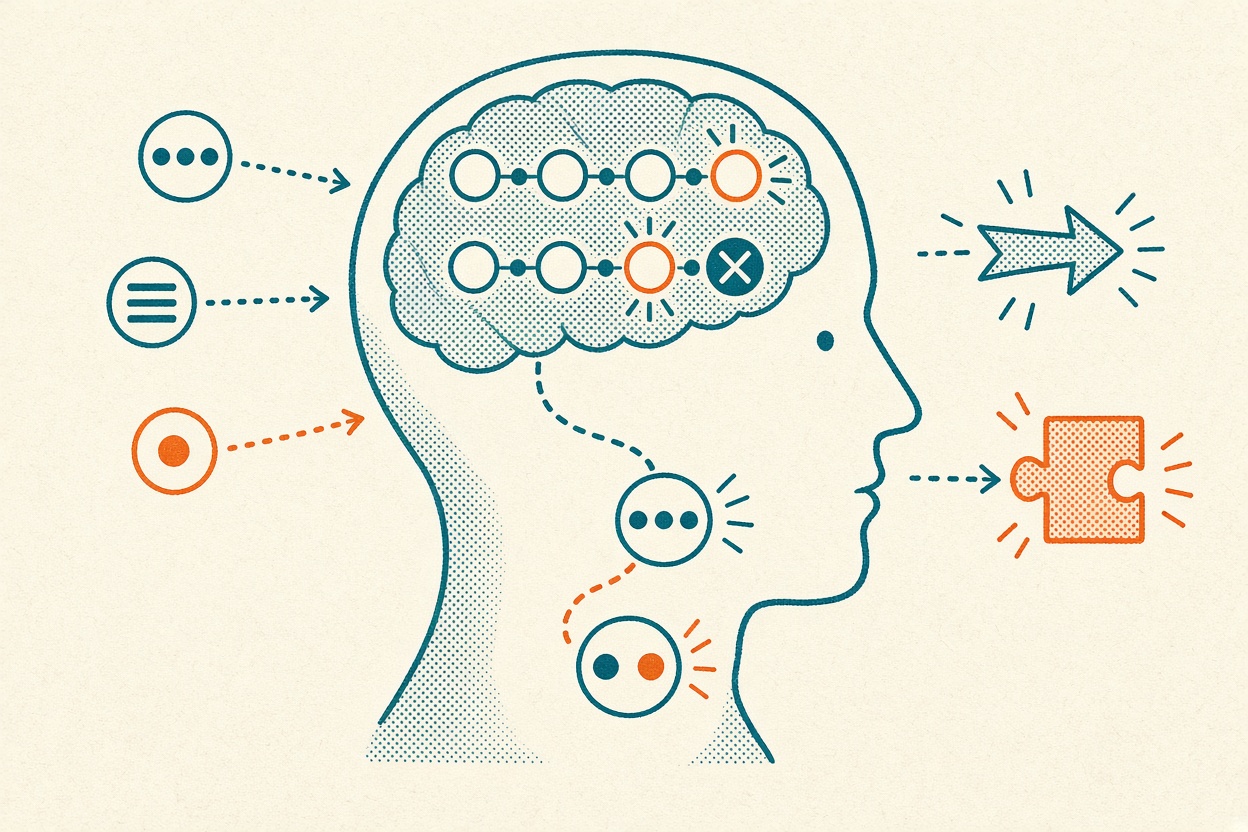 AI illustration
A new study from neuroscientists at the Picower Institute for Learning and Memory at MIT has revealed how the brain encodes and separates information about decision options to prevent interference and support memory.
In an article published by MIT News, David Orenstein of the Picower Institute wrote that the key lies in coordinated patterns of electrical activity produced by neural ensembles. These ensembles distinctly represent options both while they are being considered and after a choice is made.
“It keeps different neural ensembles, different thoughts, distinct from one another, preventing interference between them,” said senior author Earl K. Miller, Picower Professor in MIT’s Department of Brain and Cognitive Sciences.
The study, published in the journal iScience, was led by Huidi Li, a graduate student in Miller’s lab. Li said the results demonstrate that the brain does not hold information statically but instead flexibly reorganizes how it represents information to meet changing demands during the decision process.
In the experiments, two animals were trained to play a game requiring them to look toward one of two targets on a screen, selecting the one with the higher assigned reward value. The targets and their values were presented sequentially. Researchers recorded electrical activity from hundreds of neurons in the animals’ lateral prefrontal cortex, a region involved in linking options, values and actions.
Using declassifier algorithms, the team decoded the neural patterns and visualized them geometrically as subspaces on 3D graphs. Before values were assigned and a decision reached, the ensembles represented the targets based on their order of presentation. Representations for the first target were parallel to each other, as were those for the second target, but the two groups were closer to orthogonal, or perpendicular, to one another.
After the decision, different ensembles took over. Representations for chosen targets became parallel with one another regardless of original order, while unchosen targets were also parallel but orthogonal to the chosen ones.
The authors wrote that this alignment of chosen target representations could allow downstream brain areas to read out the chosen target’s location using a single decoder, independent of presentation order. The study also found that individual neurons were not fixed in specialized circuits but were multifunctional and could be recruited into different ensembles from one trial to the next.
Miller noted that the findings show the brain maintains distinct memories of both chosen and unchosen options. This separation could help with assigning credit later to support learning, such as recalling that selecting a particular target in a specific round produced a reward.
The paper’s other authors are Nikolaos Chrysanthidis, Scott Brincat and Jonas Rose. Funding came from the U.S. Office of Naval Research, the U.S. Army Research Office, the Freedom Together Foundation and the National Institutes of Health.