
MIT researchers automate lipid nanoparticle production for RNA therapeutics
An automated MIT system makes lipid nanoparticles of a requested size much faster, which the researchers say could greatly speed up development of RNA and DNA therapeutics.
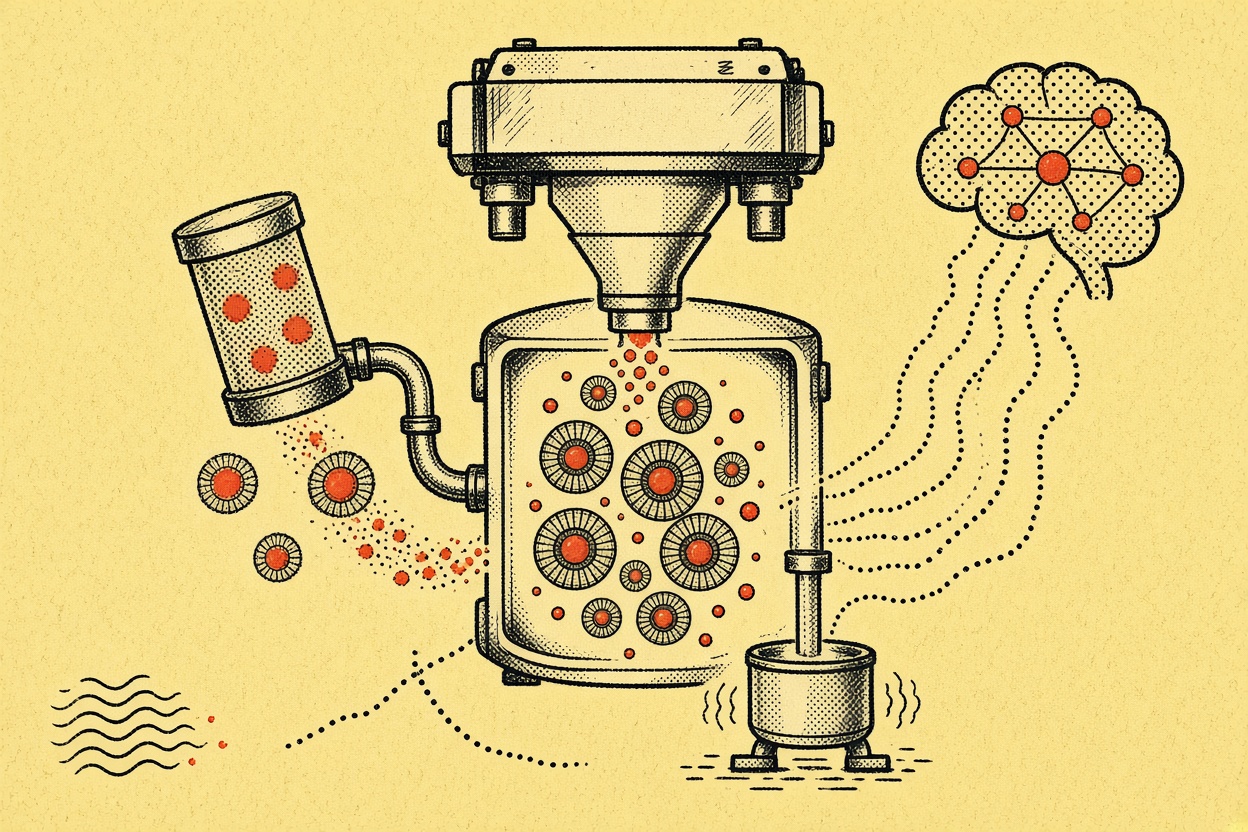 AI illustration
Researchers at MIT have automated the production of lipid nanoparticles, the fatty particles that typically package RNA vaccines and other nucleic acid therapeutics, making them much faster and with finer control over their size and shape. The researchers say the process, which can run with no human intervention, could greatly speed up the development of new RNA and DNA therapeutics, according to an article by Anne Trafton published by MIT News.
The study appears in ACS Nano. Its lead authors are MIT postdocs Cedric Devos, Aniket Udepurkar and Peter Sagmeister, and its senior author is Allan Myerson, a professor of the practice in MIT's Department of Chemical Engineering.
Designing new lipid nanoparticles often involves slow trial-and-error experiments. Tuning their size and shape can open up the possibility of reaching different organs and tissues, but Myerson said no previous production method could reliably control either.
The particles are usually made by rapidly mixing a lipid solution in ethanol with about three times as much of an mRNA solution in acidic buffer, a method that does not allow precise control of size or shape. In a study published last year in ACS Nano, the team showed they could get much better control of size by splitting the mixing into two steps and adding extra buffer after a short delay to stop the particles growing. Longer delays yield larger particles, and changing the concentration of that buffer let the researchers turn spheres into elongated particles.
The new paper automates the two-step process and adds a commercially available dynamic light scattering device that can measure particle sizes as they form. The researchers can request a size, and the system makes the particles, checks them and, if they miss the target, adjusts the delay time and other factors. Shapes can also be varied, but they must be measured outside the system. "With the second study, we automate the whole process," Sagmeister said.
With this set-up, the team studied how changing the inputs affects particle size and shape much faster than is currently possible, and used the data to train a machine-learning model that can predict which combination of factors will give a particular size or shape.
According to MIT News, the method could make it much easier for developers of RNA therapeutics to produce particles of different sizes for testing, since size determines where in the body a particle is most likely to end up. Devos said two otherwise identical therapeutics, one with a target size of 150 nanometers and the other 70 nanometers, "will behave very differently."
The researchers have filed for a patent and are working to commercialize the technology through a new company, BIZON Labs. The research was funded by the U.S. Food and Drug Administration and a Koch Institute Support (core) Grant from the National Cancer Institute.